TIME
Time is not simply a sequence but a condition of relation: it can be experienced as rhythm, measured as system, composed as sound, extended as duration, or interpreted as a problem of perception and history...
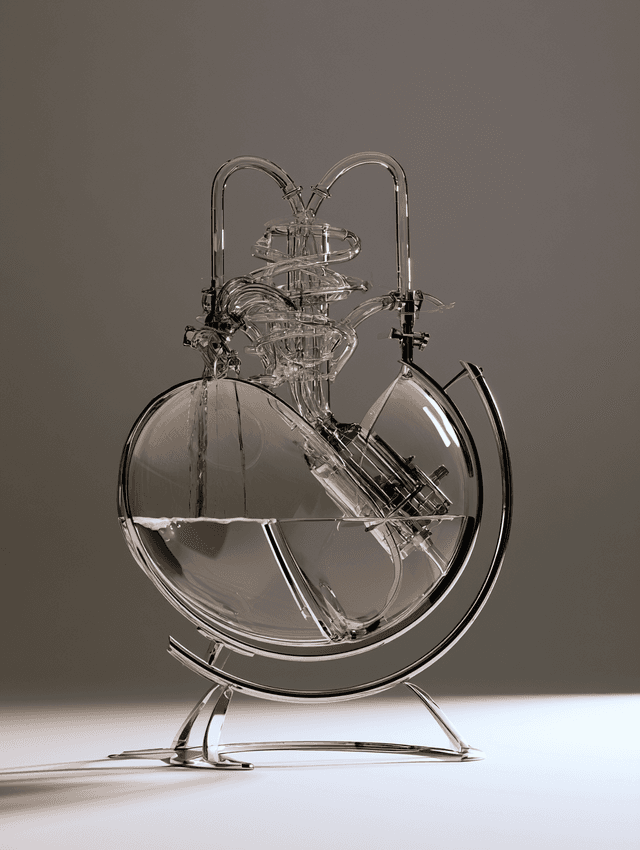
This study line investigates how exhibitions can work with and through time rather than relying on fixed spatial and temporal arrangements. Additionally, this line of study seeks to move beyond chronological approaches to exhibition-making, critically examining the limitations and possibilities inherent in existing models such as thematic or non-linear formats. It challenges traditional linear exhibition narratives by privileging multiple perspectives, interactive storytelling, and open-ended structures that actively encourage audience participation. Ultimately, it aims to reconfigure the ways stories and histories are presented, emphasizing fragmentation, multiplicity, and participatory narratives. The trajectory opens onto curatorial thought, media and technology, composition, physics, philosophy, and filmic or performative approaches to temporality.
Professors
.jpg&w=640&q=75)
Miwako Tezuka
Dr. Miwako Tezuka is the inaugural Director of Dib Bangkok, an international contemporary art museum opened in December 2025. Before this appointment, she held key leadership roles at several prominent institutions in New York, including Gallery Director of the Japan Society, Associate Curator of Contemporary Art at the Asia Society Museum, and Associate Director of Arakawa and Madeline Gins’s Reversible Destiny Foundation. Dr. Tezuka has curated numerous exhibitions, working with renowned artists such as Chen Chieh-jen, Robert Indiana, Kimsooja, Maya Lin, Mariko Mori, Yoshitomo Nara, Pinaree Sanpitak, and Yang Fudong, among others. She served as Associate Curator of the Hawaiʻi Triennial 2022, which featured works by 46 artists and collectives from across Asia and the Pacific region. Her scholarly writings have been published in exhibition catalogs and books by institutions such as the Museum of Modern Art (MoMA), New York; the Hirshhorn Museum and Sculpture Garden, Washington, DC; the Asian Art Museum, San Francisco; and the Setagaya Museum of Art, Tokyo, among others.
.JPEG&w=640&q=75)
Apichatpong Weerasethakul
Apichatpong Weerasethakul began making films and video shorts in 1994 and completed his first feature in 2000. Since 1998, he has also created installations and exhibitions across the world. Recognized as a singular voice in both cinema and contemporary art, his work weaves together memory, myth, desire, and landscape—often unfolding through non-linear, meditative structures. Apichatpong’s films include Memoria (2021) his first feature made outside Thailand, starring Tilda Swinton, which received the Cannes Jury Prize; Uncle Boonmee Who Can Recall His Past Lives, which won the Palme d’Or in 2010; Tropical Malady, winner of the Cannes Jury Prize in 2004; and Blissfully Yours, awarded Un Certain Regard in 2002. Syndromes and a Century (2006) has been widely celebrated as one of the defining films of the early 21st century. Beyond the cinema, Apichatpong’s installations explore themes of time, invisibility, and collective memory. Notable projects include Primitive (2009), Fireworks (Archives) (2014), and Invisibility (2016). More recent works such as Fic (2018), SleepCinemaHotel (2018), A Minor History (2021–2022), A Conversation with the Sun VR (2022), Solarium (2023), and Ring of Fire (2024, with Haegue Yang) continue to expand his interest in the unseen, the spiritual, and the ecological. Apichatpong’s work has been exhibited in museums, biennials, and festivals worldwide. A retrospective of his practice was presented at Centre Pompidou in Paris in 2024. He lives and works in Chiang Mai, Thailand.

Mieke Bal
Mieke Bal is author of 50 books and supervisor of 81 finished PhDs, the cultural theorist, critic, video artist and curator. She writes in an interdisciplinary perspective on cultural analysis, literature and art, focusing on gender, migratory culture, the critique of capitalism, and the political agency of art. She co-founded (1994) and directed ASCA, the Amsterdam School for Cultural Analysis, an interdisciplinary institute that is still thriving. From 2002 on, she also makes films, as a different, more in-depth, more contemporary and interactive mode of cultural analysis. Since then, writing, filmmaking and curating go together. She made the 16-channel video-installation Don Quijote: Sad Countenances (2019) with Mathieu Montanier, and a short essay film It’s About Time! Reflections on Urgency (2020). Her latest short film, made with Lena Verhoeff, Refugeedom: Lonely but not Alone, premiered in May 2023 in the SPEME program on traumatic memory. Her 50th book, Moments of Meaning-Making, was published by Valiz (Amsterdam) in 2025. Her next book on curating and semiotics is currently in production (London, Bloomsbury). www.miekebal.org

Marcus Schmickler
Marcus Schmickler works in contemporary and electronic composition, combining computer-based and instrumental music with a research-oriented approach. His multichannel works have been performed on international stages and explore the formalization of psychoacoustic and perceptual phenomena such as Shepard tones and data sonification. Schmickler writes on topics related to computer music and has received several awards, including the Rome Prize of the German Academy. He has taught at Bard College, CalArts, the Robert Schumann Hochschule, and the IEM in Graz. His compositions have been performed internationally by renowned ensembles. He lives in Cologne and Vienna. piethopraxis.org

Fabio Beltram
Fabio Beltram is an Italian physicist, known for his work in condensed matter physics and nanoscience. He earned a degree in electronic engineering from the University of Trieste in 1985 and a degree in physics from the University of Bologna in 1988. Between 1986 and 1991 he worked as a researcher in the United States at AT&T Bell Laboratories, before joining the Scuola Normale Superiore in Pisa in 1992, where he became full professor of condensed matter physics in 2000. In 2001 he founded the NEST Laboratory, an interdisciplinary research and training centre on nanoscience that today involves the Scuola Normale Superiore, the Italian National Research Council, the Istituto Italiano di Tecnologia and the Scuola Superiore Sant'Anna. He served as deputy director of the Scuola Normale Superiore from 2005 to 2010 and as its director from 2010 to 2016, a period during which the institution absorbed the Istituto Italiano di Scienze Umane and expanded its doctoral offerings to include social and political sciences. Beltram is a fellow of the American Physical Society and has been decorated as Grande Ufficiale dell'Ordine al merito della Repubblica Italiana. His research spans nanoscience and nanotechnology, and he has authored around three hundred publications in international journals and patents. He currently serves as president of the Fondazione Pisana per la Scienza.

Christopher Fynsk
Christopher Fynsk is President of the European Graduate School. He is the author of numerous monographs addressed to the work of authors such as Maurice Blanchot, Philippe Lacoue-Labarthe, and Martin Heidegger, and topics such as philosophy of language, the image, and institutional structures. He has recently published a volume with Bloomsbury Press entitled Heidegger's Turn to Art: The Uses of Rhythm.
Subscribe to the newsletter